
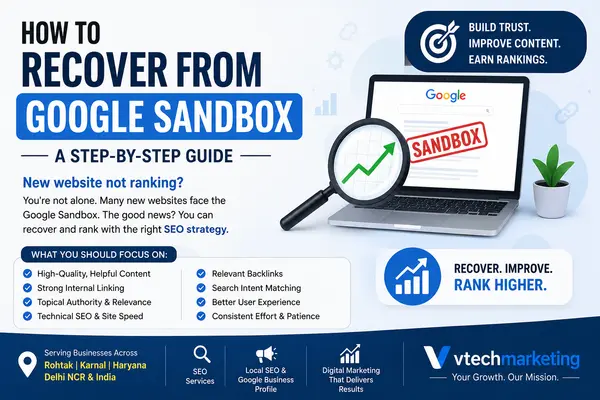
A new website can take time to gain Google’s trust. This often feels like a “Google Sandbox.” Google does not officially confirm a universal sandbox period. Still, new sites often struggle to rank early.
The solution is not chasing shortcuts. Build trust, improve content quality, earn relevant links, and satisfy search intent. A clear topical map also helps Google understand your website. This guide shows exactly what to audit and improve.
- What Is the Google Sandbox?
- Step 1: Confirm That You Are Actually Indexed
- Step 2: Audit Your Website Content
- Step 3: Match Search Intent Precisely
- Step 4: Build a Strong Topical Map
- Step 5: Strengthen Internal Linking
- Step 6: Improve User Engagement
- Step 7: Improve Core Web Vitals
- Step 8: Build Clean, Relevant Backlinks
- Step 9: Build Local SEO Signals
- Step 10: Improve E-E-A-T Signals
- Step 11: Create Content for AI Search and GEO
- Step 12: Monitor Search Console Every Week
- Your 30-Day Google Sandbox Recovery Action Plan
- Mistakes That Can Delay Recovery
- Frequently Asked Questions
- Is Google Sandbox real?
- How long does Google Sandbox last?
- Can backlinks help a new website rank?
- Should I publish more content to escape Google Sandbox?
- Can local SEO help a new website?
- Should I delete pages that do not rank?
- Does internal linking help new websites?
- How can I optimize content for AI search?
- Can a new website rank on Google quickly?
- Final Takeaway
What Is the Google Sandbox?
The Google Sandbox describes a common ranking pattern. New websites often struggle to rank for competitive keywords.
Your pages may be indexed but still receive little traffic. Some pages may rank beyond the first several results pages.
This does not always mean your website has a penalty.
Several factors can cause weak early rankings:
- Limited website history
- Few quality backlinks
- Weak topical authority
- Thin or repetitive content
- Poor internal linking
- Weak user experience
- Low brand recognition
- Strong competition
- Poor search intent matching
Google needs enough signals to understand your website.
Your job is to make those signals stronger.
Step 1: Confirm That You Are Actually Indexed
Before changing everything, check indexing first.
Search Google using:
site:vtechmarketing.in/
Replace the domain with your website.
You can also check Google Search Console.
Look at these reports:
- Pages indexed
- Pages not indexed
- Crawled but not indexed
- Discovered but not indexed
- Manual actions
- Security issues
- Search performance
If important pages are missing, fix indexing first.
Do not start aggressive link building yet.
Check Your XML Sitemap
Your sitemap should contain important URLs only.
Remove unnecessary pages.
Avoid including:
- Duplicate URLs
- Tag archives
- Thin pages
- Test pages
- Broken URLs
- Redirected URLs
Submit the clean sitemap through Search Console.
Step 2: Audit Your Website Content
Content is usually the biggest recovery opportunity.
Start with a complete content audit.
Create a spreadsheet containing:
- URL
- Primary keyword
- Search intent
- Organic clicks
- Impressions
- Current ranking
- Word count
- Backlinks
- Internal links
- Content status
Then classify every page.
Use four categories:
Keep: Strong and useful content.
Improve: Good topic, weak execution.
Merge: Multiple pages targeting the same intent.
Remove: Thin or useless content.
Do not publish dozens of weak articles.
One excellent page can outperform ten average pages.
Step 3: Match Search Intent Precisely
Ranking is not just about keywords.
Google wants pages that solve the searcher’s problem.
Consider the query:
“best CCTV installation in Rohtak”
The searcher probably wants local providers.
A general article about CCTV technology may not satisfy that intent.
A strong local page could include:
- Installation services
- Areas served
- Camera options
- Pricing factors
- Installation process
- Local examples
- FAQs
- Contact information
The same strategy works across locations.
You could create useful local pages for Rohtak, Karnal, Hisar, Sonipat, Panipat, and Bahadurgarh.
Do not simply replace the city name.
Each page should contain genuinely useful local information.
Step 4: Build a Strong Topical Map
Topical authority means covering a subject comprehensively.
Suppose your website focuses on digital marketing.
Do not publish random marketing articles.
Build connected topic clusters instead.
Example Topical Structure
Pillar: Digital Marketing
Cluster topics:
- SEO
- Technical SEO
- Local SEO
- Content marketing
- Google Business Profile
- Link building
- Keyword research
- SEO audits
- GEO optimization
- AI search optimization
Then connect related pages using contextual internal links.
This creates a logical information network.
Google can better understand your expertise.
Readers can also discover related information faster.
Step 5: Strengthen Internal Linking
Internal links are often underestimated.
Every important page should have relevant internal links.
Avoid generic anchors like:
- Click here
- Read more
- Learn more
Use descriptive anchors naturally.
For example:
Local SEO services in Delhi
is stronger than:
Click here
Link your supporting articles toward important commercial pages.
Also link your pillar pages toward supporting content.
This creates a clear topical hierarchy.
Step 6: Improve User Engagement
Traffic alone does not guarantee rankings.
Your content must satisfy visitors.
Start with the basics.
Improve Your First Screen
Visitors should understand the page immediately.
Your introduction should answer:
- What is this page about?
- Who is it for?
- What problem does it solve?
- What should the reader do next?
Avoid long introductions.
Get to the answer quickly.
Make Pages Easier to Read
Use:
- Short paragraphs
- Clear headings
- Bullet points
- Tables where useful
- Original examples
- Screenshots
- Simple explanations
Mobile readability matters too.
Test every important page on a phone.
Step 7: Improve Core Web Vitals
A slow website creates unnecessary friction.
Check your website using Google Search Console.
Pay attention to:
- Largest Contentful Paint
- Interaction to Next Paint
- Cumulative Layout Shift
Also review:
- Image sizes
- JavaScript
- CSS
- Hosting performance
- Unused plugins
- Caching
- Mobile responsiveness
Convert large images to efficient formats such as WebP.
Do not sacrifice useful content just for speed.
The goal is a fast and useful experience.
Step 8: Build Clean, Relevant Backlinks
New websites often need external authority.
But link quality matters more than link quantity.
Avoid buying hundreds of cheap backlinks.
Avoid automated link networks.
Instead, pursue relevant opportunities.
Good link sources include:
- Industry publications
- Local business websites
- Relevant directories
- Professional associations
- Guest contributions
- Digital PR
- Expert interviews
- Resource pages
For local businesses, geographic relevance can help.
A business targeting Delhi, Noida, Faridabad, Gurugram and Haryana should build relevant local signals.
A Haryana-focused business can also develop useful regional references.
The same principle applies to businesses targeting Chandigarh, India, or Dubai.
The link should make sense.
That is the key.
Step 9: Build Local SEO Signals
Local SEO can provide strong opportunities for regional businesses.
Create genuinely useful location pages.
For example:
- SEO services in Delhi
- SEO services in Noida
- SEO services in Gurugram
- SEO services in Faridabad
- SEO services in Chandigarh
But avoid doorway pages.
Each location page should offer unique value.
Include:
- Local customer problems
- Relevant services
- Area-specific examples
- FAQs
- Case studies
- Directions where appropriate
- Local testimonials
- Service availability
Keep your business information consistent.
Your name, address, phone number, and website should match across platforms.
Step 10: Improve E-E-A-T Signals
Google evaluates many signals related to experience, expertise, authority, and trust.
Make your authorship clear.
Add an author profile where appropriate.
Show relevant experience.
Use real examples.
Cite trustworthy sources when making important claims.
Create an accessible contact page.
Add an About page.
Publish genuine case studies.
Show who operates the website.
For service businesses, trust matters heavily.
People want to know who will actually deliver the service.
Step 11: Create Content for AI Search and GEO
Traditional SEO is not the only search environment anymore.
AI search systems also need clear information.
Your content should provide direct answers.
Use question-based headings.
For example:
How long does Google Sandbox last?
Answer immediately.
Then explain the factors involved.
Use concise definitions.
Add examples.
Support claims with evidence.
Create structured FAQs.
Make important facts easy to identify.
AI systems can better interpret clearly organized information.
This is one reason semantic SEO matters.
Your content should cover related entities and concepts naturally.
Do not stuff keywords.
Build context instead.
Step 12: Monitor Search Console Every Week
Do not make changes blindly.
Track your progress.
Watch:
- Impressions
- Clicks
- Average position
- CTR
- Indexed pages
- Queries
- New ranking keywords
- Pages gaining visibility
Sometimes impressions increase before clicks do.
That can be an early positive signal.
Look for keywords moving from positions 50–100.
Then improve those pages.
Small ranking gains can reveal where Google sees potential.
Your 30-Day Google Sandbox Recovery Action Plan
Week 1: Technical Cleanup
- Verify Search Console
- Check indexing
- Fix crawl errors
- Submit sitemap
- Check robots.txt
- Review canonical tags
- Improve mobile performance
- Fix broken links
Week 2: Content Audit
- Identify thin pages
- Merge competing pages
- Improve outdated content
- Match search intent
- Add original examples
- Improve titles and descriptions
- Strengthen internal links
Week 3: Authority Building
- Create a topical map
- Publish supporting articles
- Build relevant backlinks
- Improve author information
- Create useful local pages
- Strengthen business profiles
- Promote genuinely useful content
Week 4: Measurement
- Review Search Console data
- Identify improving queries
- Improve pages with impressions
- Refresh underperforming content
- Check engagement signals
- Review internal linking
- Plan the next content cluster
Mistakes That Can Delay Recovery
Avoid making drastic changes every few days.
Do not constantly change URLs.
Do not rewrite every page without evidence.
Do not publish content just to hit a word count.
Do not purchase massive backlink packages.
Do not create dozens of nearly identical city pages.
Do not stuff keywords into paragraphs.
Do not chase every new SEO trend.
Consistency beats panic.
A new website needs time and strong signals.
Your goal is not to “escape” a mysterious penalty.
Your goal is to build a website Google can confidently understand and recommend.
Frequently Asked Questions
Is Google Sandbox real?
Google does not officially confirm a universal Google Sandbox. New websites can still experience limited visibility while Google evaluates their content, authority, and other signals.
How long does Google Sandbox last?
There is no fixed duration. New websites may improve within weeks or take several months. Competition, content quality, authority, and technical health all matter.
Can backlinks help a new website rank?
Yes, relevant and trustworthy backlinks can strengthen authority. Focus on quality and relevance rather than buying large quantities of links.
Should I publish more content to escape Google Sandbox?
Not necessarily. Publishing more pages helps only when those pages satisfy real search intent. High-quality topical coverage is better than mass publishing.
Can local SEO help a new website?
Yes. Strong local signals can help businesses compete for geographic searches. Useful city pages, consistent business information, reviews, and relevant local links can all help.
Should I delete pages that do not rank?
Not automatically. First check their quality, intent, backlinks, and impressions. Improve or consolidate weak pages before removing them.
Does internal linking help new websites?
Yes. Strong internal linking helps users discover content. It also helps search engines understand relationships between pages and topics.
How can I optimize content for AI search?
Give direct answers first. Use clear headings and structured information. Cover related entities naturally. Add original experience, examples, and trustworthy supporting information.
Can a new website rank on Google quickly?
Yes, but it depends on the query and competition. Low-competition searches can rank quickly. Competitive keywords usually require stronger authority and sustained effort.
Final Takeaway
Recovering from the Google Sandbox is not about finding a secret trick.
It is about building trust, relevance, authority, and usefulness.
Start with technical problems.
Then fix weak content.
Build a strong topical map.
Strengthen internal links.
Earn relevant backlinks.
Improve local signals where appropriate.
Finally, monitor Search Console and refine your strategy.
Do not measure success only by today’s ranking.
Look for better indexing, rising impressions, expanding keyword visibility, stronger engagement, and growing authority.
Those signals show that your website is moving in the right direction.