
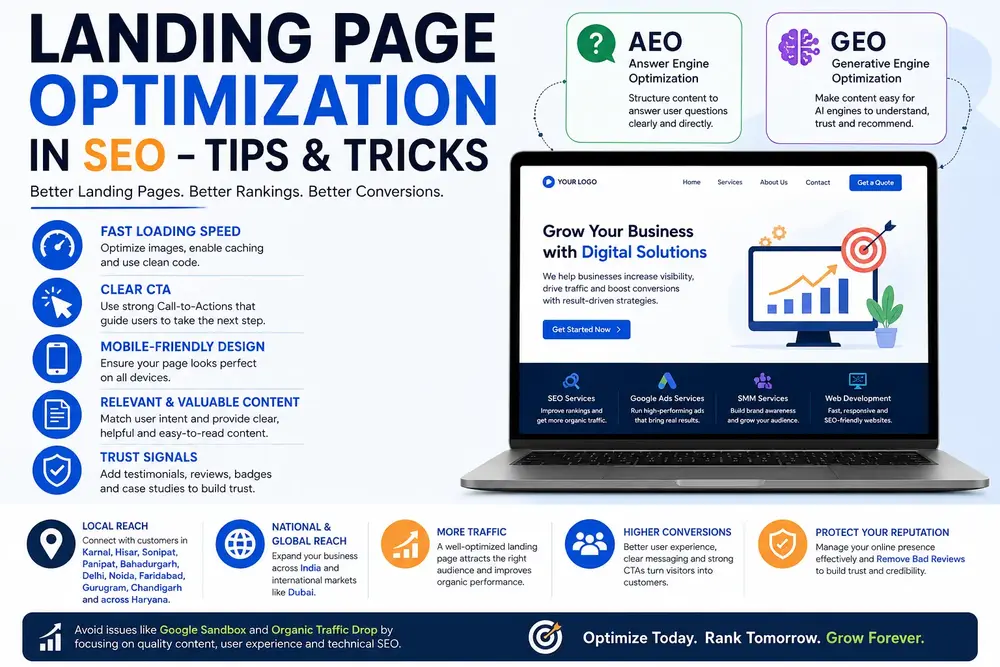
A landing page is often the first real interaction a potential customer has with your business. Someone may discover your website through Google, an ad, social media, or an AI-powered search engine—but whether they stay, explore, and convert depends heavily on what happens after the click.
That is where Landing Page Optimization (LPO) comes in.
Landing Page Optimization is the process of improving a page so it loads quickly, answers the visitor’s intent, works smoothly on every device, and guides users toward a specific action. From improving conversions to supporting organic rankings, a well-optimized landing page can become one of the strongest assets in your digital marketing strategy.
Whether you are targeting customers in Karnal, Hisar, Sonipat, Panipat, Bahadurgarh, Delhi, Noida, Faridabad, Gurugram, or Chandigarh, the fundamentals remain the same: give people exactly what they came looking for, without making them work for it.
- What Is Landing Page Optimization in SEO?
- AEO: Optimize Landing Pages for Answer Engines
- GEO: Prepare Your Content for Generative Search
- Local SEO and Global Reach
- Don't Ignore Technical SEO
- Dynamic & Static Website: Which Is Better for Landing Pages?
- Final Thoughts
- Frequently Asked Questions
- What is Landing Page Optimization in SEO?
- Does landing page optimization improve SEO?
- How important is page speed for landing pages?
- What is AEO in SEO?
- What is GEO in digital marketing?
- Should every business create separate local landing pages?
- Can landing pages work for Google Ads as well as SEO?
- What is the most important landing page optimization tip?
What Is Landing Page Optimization in SEO?
Landing Page Optimization in SEO means improving the content, technical performance, structure, usability, and relevance of a landing page to satisfy both search engines and users.
For example, if someone searches for “SEO Services in Haryana,” they should land on a page that immediately explains what your SEO services include, who they are for, what results can realistically be expected, and how the visitor can get started.
A strong landing page should answer three questions quickly:
- What does this business offer?
- Why should I trust it?
- What should I do next?
When those answers are clear, SEO traffic has a much better chance of turning into genuine enquiries.
1. Improve Landing Page Speed
Nobody enjoys waiting for a website to load.
Page speed affects user experience, engagement, and the likelihood that visitors will continue browsing. A slow landing page can also waste traffic that you worked hard to acquire through organic search or paid advertising.
How to improve speed
- Compress large images.
- Use modern image formats such as WebP.
- Minify unnecessary CSS and JavaScript.
- Enable browser caching.
- Use reliable hosting.
- Reduce unnecessary third-party scripts.
- Keep the page design clean and lightweight.
Speed becomes even more important for mobile users, who may be browsing on slower connections.
2. Create a Clear and Powerful CTA
A landing page should not leave visitors wondering what to do next.
Your Call-to-Action (CTA) should be visible, specific, and relevant to the page.
Instead of a vague button such as “Submit,” consider:
- Get a Free Consultation
- Request a Quote
- Book a Strategy Call
- Get Started Today
- Talk to an Expert
For a company offering Google Ads Services, for example, “Get Your Google Ads Audit” can be much more meaningful than a generic button.
The CTA should also match the visitor’s intent. Someone searching for Remove Bad Reviews may want an explanation and consultation, not an unrelated sales pitch.
3. Make the Landing Page Mobile-Friendly
A significant portion of modern search traffic comes from smartphones. Your landing page therefore needs to work just as well on a small screen as it does on a desktop.
Check whether:
- Text is easy to read without zooming.
- Buttons are large enough to tap.
- Images resize correctly.
- Navigation is simple.
- Forms are short and easy to complete.
- Important information appears near the top.
A beautiful desktop page that becomes difficult to use on mobile is not truly optimized.
4. Match Content With Search Intent
One of the most common landing-page mistakes is creating content around keywords rather than people.
Search intent should come first.
If a visitor searches for SMM Services, the landing page should clearly discuss social media marketing, platforms, strategy, content, campaigns, and expected outcomes.
Similarly, someone looking for Web Development Services needs information about development capabilities, technologies, process, timelines, and support.
Keep the content focused
Avoid stuffing every possible keyword into one page. Instead, build topical relevance naturally through:
- Clear H1 and H2 headings
- Helpful supporting content
- Related terms and concepts
- Relevant internal links
- FAQs
- Original examples
- Trust signals and proof
Google does not need a page to repeat the same phrase dozens of times to understand its subject.
5. Use Trust Signals
Visitors are naturally cautious before sharing their contact information.
Trust signals can reduce that hesitation.
Consider adding:
- Customer testimonials
- Case studies
- Reviews
- Certifications
- Client logos
- Years of experience
- Transparent service information
- Contact details
- Clear business information
For a local company in Haryana, mentioning genuine service coverage across places such as Karnal, Panipat, Sonipat, or Gurugram can also make the page more relevant to local visitors—provided those locations genuinely represent your service area.
AEO: Optimize Landing Pages for Answer Engines
Search is no longer limited to traditional Google results.
People increasingly ask questions and expect direct answers from AI-powered search and answer engines. This is where AEO (Answer Engine Optimization) becomes important.
AEO focuses on structuring content so that answers can be easily understood, extracted, and presented to users.
Use direct answers
Instead of hiding the answer inside a long paragraph, give a concise response immediately after a relevant question.
For example:
What is Landing Page Optimization?
Landing Page Optimization is the process of improving a landing page’s content, design, speed, usability, and relevance to increase search visibility and conversions.
This structure is easier for both humans and answer engines to understand.
Add FAQ sections
FAQs are particularly useful because they naturally reflect the questions users ask.
Use clear questions such as:
- What is landing page optimization in SEO?
- How does landing page speed affect SEO?
- Does mobile optimization improve conversions?
- How can landing pages improve Google Ads performance?
- What is the difference between SEO and LPO?
Keep answers concise, factual, and genuinely useful.
GEO: Prepare Your Content for Generative Search
GEO (Generative Engine Optimization) focuses on improving the chances that your content is understood, referenced, or surfaced by generative AI search experiences.
The basic principle is simple: make your information easy to understand and easy to verify.
For GEO-friendly landing pages:
- Answer important questions directly.
- Use descriptive headings.
- Provide original and useful information.
- Support claims with credible evidence where appropriate.
- Demonstrate real-world expertise.
- Keep important facts clearly written.
- Avoid unnecessary keyword repetition.
A page discussing an Organic Traffic Drop, for instance, should explain potential causes such as technical issues, algorithm changes, indexing problems, content quality, or lost rankings rather than simply repeating the keyword.
Local SEO and Global Reach
A landing page can be designed for a specific local market without making the content feel unnatural.
A business serving Delhi-NCR might create dedicated service pages for Delhi, Noida, Faridabad, Bahadurgarh, and Gurugram. A business expanding across India can build relevant regional pages based on actual service availability.
At the same time, businesses targeting international customers in markets such as Dubai can create dedicated pages that address local expectations, market conditions, and customer needs.
The important point is authenticity. Don’t create dozens of nearly identical city pages simply by replacing the city name. Give each page genuinely useful local information.
Don’t Ignore Technical SEO
Even excellent content can struggle if the technical foundation is weak.
Check your landing pages for:
- Proper indexing
- Correct canonical tags
- Descriptive URLs
- Optimized title tags
- Meta descriptions
- Logical heading structure
- Internal links
- Image alt text
- Mobile usability
- Core Web Vitals
- HTTPS
- Broken links
Also, don’t panic when your website does not rank immediately. New websites and pages can take time to establish trust and visibility. Discussions around the Google Sandbox often refer to the possibility that new sites may experience an initial period of limited visibility, although Google has not officially confirmed a specific “sandbox” mechanism.
Dynamic & Static Website: Which Is Better for Landing Pages?
Both can work extremely well.
A Dynamic & Static Website can be optimized for SEO as long as the underlying pages are technically sound, fast, crawlable, and useful.
Static pages can offer excellent speed and simplicity, while dynamic websites can provide advanced functionality and personalized experiences. The technology itself is less important than how effectively the website is built and optimized.
Final Thoughts
Landing Page Optimization is not about adding more keywords or making a page look flashy. It is about creating a better experience from search result to conversion.
A successful landing page combines SEO, UX, speed, persuasive copy, clear CTAs, technical optimization, AEO, and GEO.
Whether your audience is searching from Karnal or Chandigarh, Delhi or Dubai, the principle remains the same: understand the user’s question, provide the best answer, establish trust, and make the next step obvious.
When those elements work together, your landing page becomes more than a page designed to rank—it becomes a page designed to perform.
Frequently Asked Questions
What is Landing Page Optimization in SEO?
Landing Page Optimization is the process of improving a webpage’s content, technical performance, usability, and relevance to increase search visibility, user engagement, and conversions.
Does landing page optimization improve SEO?
Yes. Better relevance, content quality, mobile usability, page experience, internal linking, and technical SEO can help a landing page perform better in organic search.
How important is page speed for landing pages?
Page speed is highly important because slow pages can create a poor user experience and increase abandonment. A fast, responsive page provides a stronger foundation for both SEO and conversions.
What is AEO in SEO?
AEO, or Answer Engine Optimization, is the practice of structuring content so that search and answer engines can understand and provide direct answers to users’ questions.
What is GEO in digital marketing?
GEO, or Generative Engine Optimization, focuses on making content clear, useful, trustworthy, and easy for generative AI systems to understand and potentially surface in AI-powered search experiences.
Should every business create separate local landing pages?
Not necessarily. Separate local landing pages are useful when a business genuinely serves different locations and can provide unique, relevant information for each market.
Can landing pages work for Google Ads as well as SEO?
Absolutely. A well-optimized landing page can support both organic SEO and paid campaigns such as Google Ads by improving relevance, user experience, and conversion potential.
What is the most important landing page optimization tip?
Start with user intent. If your landing page immediately answers what the visitor searched for, demonstrates why your business is credible, and provides a clear next step, you have already built a strong foundation for SEO and conversions.