
In today’s digital-first world, your website is often the first impression customers have of your business. Whether you’re a startup, local business, enterprise, or eCommerce brand, choosing the right type of website can directly influence your online growth, user experience, and search engine rankings.
One of the most common questions business owners ask is: Should I choose a static website or a dynamic website?
The answer depends on your business goals, budget, scalability requirements, and long-term digital marketing strategy. At vtechmarketing, we’ve helped businesses across Rohtak, Karnal, Hisar, Sonipat, Panipat, Bahadurgarh, Delhi, Noida, Faridabad, Gurugram, Chandigarh, Haryana, India, Bangalore, and even Dubai select the right website architecture that aligns with their growth plans.
This detailed guide explains everything you need to know about the difference between dynamic and static websites, including their advantages, disadvantages, real-world applications, SEO impact, and how to decide which one fits your business.
- What Is a Static Website?
- Limitations of Static Websites
- What Is a Dynamic Website?
- Advantages of a Dynamic Website
- Disadvantages of Dynamic Websites
- Dynamic vs Static Website: Quick Comparison
- Which Website Is Better for SEO?
- Static Website Use Cases
- Dynamic Website Use Cases
- Which Businesses Should Choose a Static Website?
- Which Businesses Should Choose a Dynamic Website?
- Can You Convert a Static Website Into a Dynamic Website?
- How vtechmarketing Helps Businesses Choose the Right Website
- Frequently Asked Questions (FAQs)
- Conclusion
What Is a Static Website?
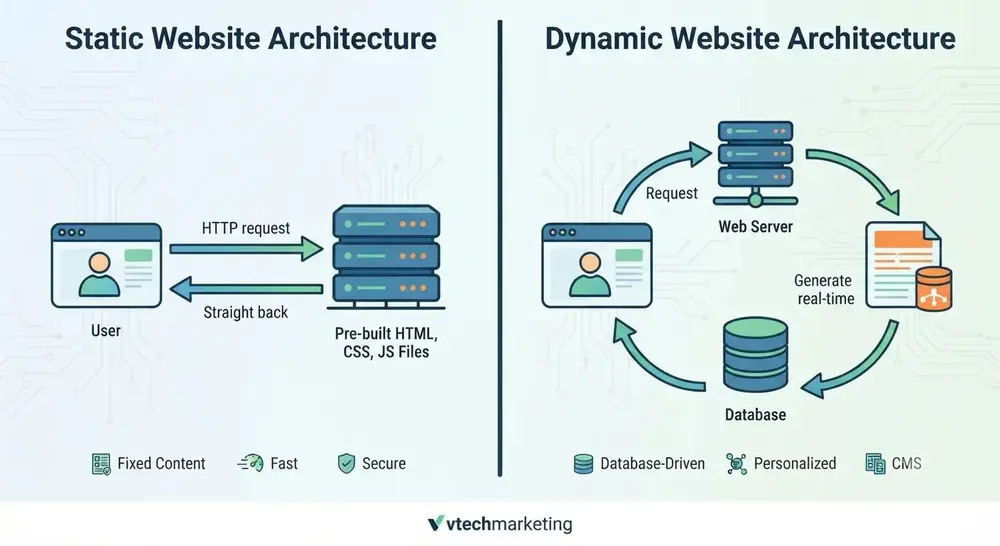
A static website consists of fixed web pages created using HTML, CSS, and sometimes JavaScript. Every visitor sees the same content unless a developer manually edits the source files.
Think of it as a printed brochure on the internet. The information remains unchanged until someone updates it manually.
Key Features of a Static Website
- Fixed content
- Faster loading speed
- Lower hosting requirements
- Simple architecture
- Enhanced security due to fewer vulnerabilities
- Ideal for informational websites
Advantages of a Static Website
1. Lightning-Fast Performance
Since static websites don’t generate pages from a database, they load almost instantly. Faster websites improve user experience and positively influence Core Web Vitals.
2. Better Security
Without databases or server-side processing, hackers have fewer entry points. This significantly reduces security risks.
3. Affordable Development
Static websites are generally less expensive to develop and maintain, making them an excellent choice for startups and small businesses.
4. Reliable Hosting
Static files can be hosted virtually anywhere, reducing hosting costs while ensuring consistent uptime.
Limitations of Static Websites
Although static websites have many advantages, they aren’t suitable for every business.
Some limitations include:
- Manual updates for every page
- Difficult to manage large websites
- Limited user interaction
- No login systems
- No personalized content
- Not suitable for complex applications
If your business frequently updates products, blogs, or customer information, a static website may become difficult to manage over time.
What Is a Dynamic Website?
A dynamic website generates content in real time using server-side programming languages and databases. Instead of displaying the same information to every visitor, dynamic websites can personalize content based on user behavior, preferences, or account details.
Popular platforms like WordPress, Shopify, Facebook, Amazon, and LinkedIn are dynamic websites.
Key Features of a Dynamic Website
- Database-driven
- Easy content management
- Personalized user experience
- Interactive functionality
- Scalable architecture
- Admin dashboard for updates
Advantages of a Dynamic Website
1. Easy Content Management
With a Content Management System (CMS), anyone can update pages, publish blogs, or add products without touching code.
2. Highly Scalable
As your business grows, your website can easily expand with:
- Blogs
- Products
- Customer accounts
- Booking systems
- Payment gateways
- Membership portals
3. Better User Engagement
Dynamic websites allow visitors to:
- Register accounts
- Leave reviews
- Submit forms
- Search products
- Save preferences
- Receive personalized recommendations
4. Perfect for Digital Marketing
Businesses investing in SEO, content marketing, PPC, and Local SEO benefit from dynamic websites because publishing fresh content becomes effortless.
At vtechmarketing, most businesses aiming for long-term digital growth choose dynamic websites due to their flexibility and marketing potential.
Disadvantages of Dynamic Websites
Dynamic websites aren’t perfect either.
Some drawbacks include:
- Higher development cost
- More maintenance
- Regular software updates
- Increased hosting requirements
- Greater security responsibilities
- Slightly slower loading speed if not optimized
Fortunately, proper optimization, caching, CDN integration, and technical SEO can minimize these issues.
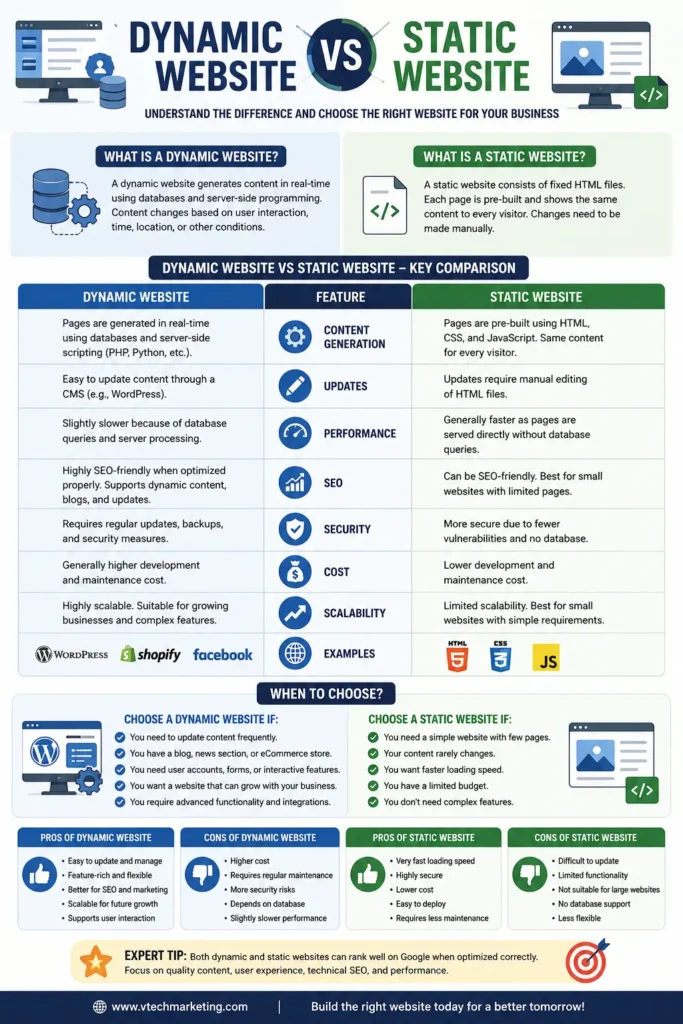
Dynamic vs Static Website: Quick Comparison
| Feature | Static Website | Dynamic Website |
|---|---|---|
| Content | Fixed | Changes Automatically |
| Speed | Very Fast | Fast with Optimization |
| Database | No | Yes |
| CMS | No | Yes |
| User Login | No | Yes |
| Blogging | Difficult | Easy |
| SEO Updates | Manual | Easy |
| Maintenance | Low | Medium |
| Scalability | Limited | High |
| Cost | Lower | Higher |
Which Website Is Better for SEO?
This is where many business owners get confused.
The truth is:
Google does not rank websites simply because they are static or dynamic.
Instead, Google evaluates factors such as:
- Page speed
- Helpful content
- Mobile responsiveness
- User experience
- Site structure
- Internal linking
- Core Web Vitals
- Backlinks
- Technical SEO
- Search intent satisfaction
A well-optimized static website can outrank a poorly optimized dynamic website—and vice versa.
However, dynamic websites often have an edge because they make it easier to publish fresh, relevant content consistently. Businesses can add blogs, FAQs, case studies, and landing pages without relying on developers, helping improve visibility over time.
Static Website Use Cases
A static website is ideal for:
- Personal portfolios
- Business profile websites
- Landing pages
- Event websites
- Digital brochures
- Small company websites
- Simple informational websites
If your business rarely changes content, a static website can be an efficient solution.
Dynamic Website Use Cases
A dynamic website is best suited for:
- eCommerce stores
- Educational portals
- Real estate websites
- Hospital websites
- News portals
- Membership platforms
- Booking websites
- SaaS companies
- Corporate websites
- Large business portals
Businesses planning to expand their digital presence generally benefit more from dynamic functionality.
Cost Comparison
Development costs vary depending on complexity, features, and customization.
Generally:
Static Website
- Lower initial investment
- Minimal maintenance
- Budget-friendly hosting
Dynamic Website
- Higher development investment
- Ongoing maintenance
- Premium hosting may be required
- Better long-term scalability
Rather than focusing solely on upfront cost, consider the long-term value the website brings to your business.
Which Businesses Should Choose a Static Website?
You should consider a static website if you:
- Need only a few pages
- Rarely update content
- Want a fast-loading website
- Have a limited budget
- Don’t require customer accounts or advanced features
Which Businesses Should Choose a Dynamic Website?
A dynamic website is the better choice if you:
- Publish blogs regularly
- Offer online services
- Sell products
- Need customer logins
- Collect inquiries frequently
- Require appointment booking
- Plan to grow your business over time
Many businesses across Delhi, Noida, Faridabad, Gurugram, and Chandigarh choose dynamic websites because they support long-term digital marketing strategies, while smaller organizations in Karnal, Hisar, Sonipat, Panipat, and Haryana, across India, or into international markets such as Dubai increasingly adopt scalable dynamic solutions to manage content and customer engagement more efficiently. Technology-driven brands in Bangalore also prefer dynamic platforms for their flexibility and integration capabilities.
Can You Convert a Static Website Into a Dynamic Website?
Yes.
Many businesses begin with a static website and later migrate to a dynamic platform like WordPress or a custom CMS as their needs evolve.
Migration usually involves:
- Database integration
- CMS setup
- Content migration
- URL preservation
- SEO optimization
- Performance testing
A carefully planned migration helps preserve search rankings while adding powerful new features.
How vtechmarketing Helps Businesses Choose the Right Website
Every business has unique goals, and there isn’t a one-size-fits-all solution.
At vtechmarketing, we assess your business objectives, audience, growth plans, and digital marketing strategy before recommending the ideal website type. Whether you need a lightweight static website for a professional online presence or a feature-rich dynamic platform designed for lead generation, eCommerce, or content marketing, the focus is always on performance, usability, and search engine optimization.
From responsive design and technical SEO to speed optimization and scalable development, vtechmarketing builds websites that are designed to support sustainable online growth.
Frequently Asked Questions (FAQs)
Is a static website faster than a dynamic website?
Yes. Static websites generally load faster because pages are served directly without database queries. However, a well-optimized dynamic website can also achieve excellent performance.
Which website is better for SEO?
Both can rank well when optimized correctly. Success depends on content quality, technical SEO, user experience, and website performance rather than whether the site is static or dynamic.
Can a small business start with a static website?
Absolutely. If your content rarely changes and your primary goal is to establish an online presence, a static website can be a practical and cost-effective choice.
Are dynamic websites more secure?
Dynamic websites can be highly secure when maintained properly with regular updates, strong authentication, secure hosting, and ongoing monitoring. They simply require more attention than static websites.
Conclusion
Choosing between a dynamic website and a static website isn’t about selecting the “better” technology—it’s about choosing the right solution for your business objectives.
A static website offers simplicity, speed, affordability, and strong security for businesses with minimal content updates. A dynamic website, on the other hand, provides flexibility, scalability, advanced functionality, and easier content management, making it the preferred choice for businesses focused on long-term digital growth.
Before making a decision, evaluate your current needs, future expansion plans, content strategy, and marketing goals. Investing in the right website today can save significant time and resources as your business evolves.
If you’re unsure which option is best, vtechmarketing can help you build a website that is fast, SEO-friendly, user-focused, and ready to support your growth—whether you’re serving customers locally or expanding into competitive markets across Haryana, India, or beyond.