
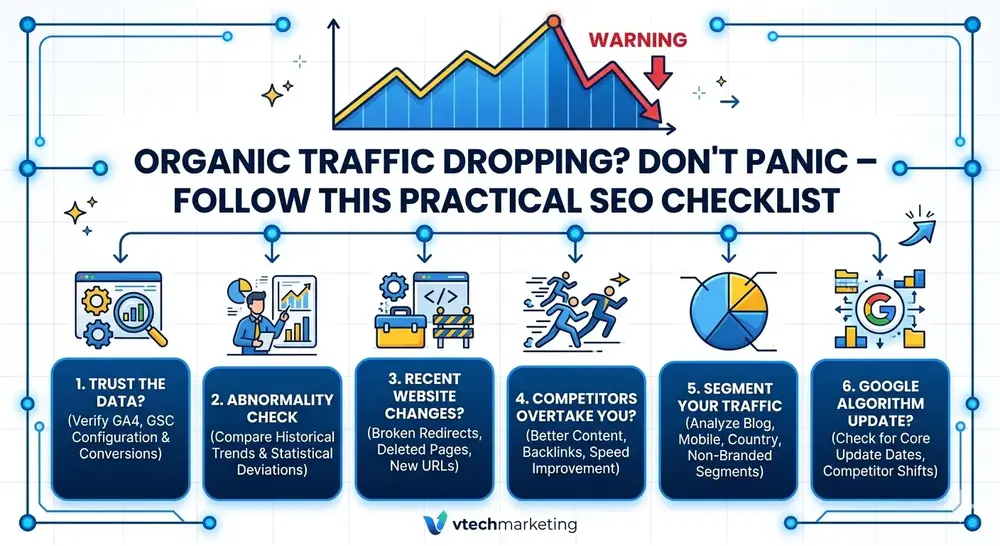
Why Does Your Organic Traffic Drop? – A Practical SEO Checklist
If you’ve been working in SEO long enough, you already know this feeling. You open Google Analytics or Search Console one morning, and suddenly the graph looks like it fell off a cliff. Organic traffic is down. Rankings are shaky. Panic starts creeping in. Now here’s the thing — not every traffic drop is a disaster. Sometimes it’s just bad tracking. Sometimes it’s seasonal. And sometimes Google decides to shake the table with another algorithm update. The trick is knowing what actually happened before you start changing random things on your website.
At vtechmarketing, we’ve seen businesses across Karnal, Hisar, Sonipat, Panipat, Bahadurgarh, Delhi, Noida, Faridabad, Gurugram, Chandigarh, Haryana, India, and even Dubai face sudden SEO drops for completely different reasons. One website lost rankings after a redesign. Another accidentally blocked pages from indexing. One client simply had broken analytics tracking. Different symptoms. Different cures. So before you hit the panic button, walk through this checklist carefully.
First Things First — Can You Trust the Data?
This sounds obvious, but you’d be surprised how many “SEO disasters” turn out to be tracking issues. Maybe your Google Analytics code stopped firing after a website update. Maybe GA4 was configured incorrectly. Maybe filters changed. It happens more often than people admit.
Before doing anything else, compare your organic traffic data with:
- Google Search Console clicks
- Overall conversions
- Impressions
- Direct traffic trends
- Paid traffic consistency
If multiple metrics suddenly look strange at the same time, there’s a good chance the issue is with tracking rather than SEO itself. Think of it this way — you wouldn’t repair an engine just because the fuel gauge looks weird.
Is the Traffic Drop Actually Abnormal?
Traffic naturally moves up and down. Weekends behave differently from weekdays. Seasonal businesses fluctuate all the time. A 10% dip may feel scary, but statistically, it might be completely normal. A smart approach is comparing your current traffic against historical trends using standard deviation in Excel or Google Sheets. If the drop sits far outside the normal range, then yes, you probably have a real issue on your hands. A lot of website owners skip this step and start “fixing” things that were never broken in the first place.
Did Google Roll Out an Algorithm Update?
Google changes its algorithm constantly. Some updates are tiny. Others hit websites like a freight train. If your rankings suddenly disappeared overnight, check whether Google released a core update around the same date. Many websites lose visibility because Google re-evaluates content quality, backlinks, user experience, or relevance. This doesn’t always mean your website is bad. Sometimes competitors simply improved faster. At vtechmarketing, we often advise clients in Delhi and Gurugram not to react emotionally to every update. Knee-jerk SEO changes can create bigger problems than the update itself.
Is the Drop Affecting a Specific Segment?
One of the biggest mistakes people make is looking only at total traffic. You need to segment the data.
Ask questions like:
- Did blog traffic fall?
- Did product pages lose visibility?
- Is mobile traffic down?
- Did traffic from one country disappear?
- Are only non-branded keywords affected?
Segmentation helps you narrow down the source quickly. If only blog traffic dropped, maybe informational keywords lost rankings. If only mobile users disappeared, technical issues might be involved. SEO & SMM problems leave clues. You just have to read them properly.
Have You Been Penalized?
Manual penalties still happen, although not as often as they used to. Open Google Search Console and check the “Manual Actions” section. If Google penalized your site for spammy backlinks, thin content, or manipulative SEO practices, you’ll usually find a warning there. Another simple check? Search your brand name on Google. If your website barely appears for its own brand searches, something is seriously wrong.
Did You Change Anything on the Website Recently?
Honestly, this is one of the most common reasons behind traffic loss. A developer changes URLs. Navigation gets redesigned. Internal links disappear. Pages are redirected incorrectly. Suddenly rankings collapse. Even small adjustments can create SEO chaos if they aren’t handled carefully. We’ve seen businesses in Noida and Chandigarh unintentionally damage rankings after switching frameworks or redesigning websites without preserving SEO structure.
Common culprits include:
- Broken redirects
- Deleted pages
- Slow page speed
- JavaScript rendering issues
- Missing metadata
- Changed heading structure
Sometimes the problem is sitting right under your nose.
Did Competitors Overtake You?
SEO isn’t a solo race. Your competitors are working too. Maybe they published better content. Maybe they improved page speed. Maybe they built stronger backlinks. Or maybe a completely new player entered the market swinging hard. Use SEO tools to compare ranking movements. Check whether competitors gained visibility for keywords you used to dominate. This happens a lot in competitive markets like Faridabad, Panipat, and Dubai, where businesses aggressively invest in digital growth. SEO rankings are never permanent. You have to defend your position constantly.
Did Organic Traffic Turn Into Direct Traffic?
Here’s something many businesses overlook. Sometimes traffic doesn’t disappear — it simply gets misclassified. A tracking issue, HTTPS migration problem, or attribution error can push organic visits into direct or “dark” traffic categories. If your direct traffic suddenly rises while organic traffic falls, that’s a major clue. Analytics data can be messy. Never assume the labels are always accurate.
Has Google Changed the Search Results Page?
Google keeps more users inside the search results than ever before. Featured snippets, answer boxes, local packs, AI-generated summaries, and instant answers can reduce clicks even when your rankings stay stable. Your website may still rank on page one, but users may get their answers without clicking. This is especially common for informational queries. Regularly review search engine results pages manually. Look at what users actually see now compared to six months ago. SEO today isn’t just about rankings. It’s about visibility and click behavior.
Is the Traffic Drop Branded or Non-Branded?
This distinction matters a lot. If branded traffic declines, the issue may involve brand awareness, reputation, or offline marketing rather than SEO. If non-branded keywords are falling, then your SEO visibility likely weakened. Homepage traffic usually connects heavily with branded searches, while service pages and blogs depend more on non-branded discovery. At vtechmarketing, we often help businesses across Haryana identify whether the issue is truly SEO-related or part of a broader branding challenge.
Are Fewer Pages Indexed?
Sometimes pages quietly disappear from Google’s index. That can happen because of:
- Accidental noindex tags
- Robots.txt blocks
- Canonical tag errors
- Crawl issues
- Deleted pages
Use the Index Coverage report inside Google Search Console to spot indexing problems quickly. You’d be amazed how often websites accidentally tell Google not to index important pages. And yes, it hurts rankings badly.
Did You Lose Backlinks or Referring Domains?
Backlinks still matter. A lot. If high-quality websites remove links pointing to your pages, your authority can weaken over time. This may happen because:
- Pages were deleted
- Websites shut down
- Competitors replaced your links
- PR mentions disappeared
SEO tools can help monitor backlink losses before they become serious problems. For businesses competing in crowded markets like Delhi and Gurugram, losing a handful of strong links can make rankings wobble pretty quickly.
Is Paid Advertising Affecting Organic Traffic?
SEO and SEM sometimes cannibalize each other. If your paid campaigns aggressively target branded keywords, users may click ads instead of organic listings.
That doesn’t necessarily mean SEO performance collapsed. The clicks may simply be shifting channels. Compare SEO and PPC trends side by side. In some situations, pausing certain ad campaigns briefly can reveal whether paid traffic is stealing organic clicks.
Don’t Panic — Diagnose First
A sudden traffic drop can feel brutal, especially when leads and sales start slowing down. But reacting emotionally usually makes things worse. SEO is rarely black and white. One traffic decline could involve technical issues, algorithm changes, lost backlinks, shifting user behavior, stronger competitors, or simple tracking errors. The key is staying calm and investigating methodically. At vtechmarketing, we help businesses across Rohtak, Karnal, Hisar, Sonipat, Panipat, Bahadurgarh, Delhi, Noida, Faridabad, Gurugram, Chandigarh, Haryana, India, Bangalore and Dubai uncover the real reasons behind organic traffic loss and build recovery strategies that actually work.